
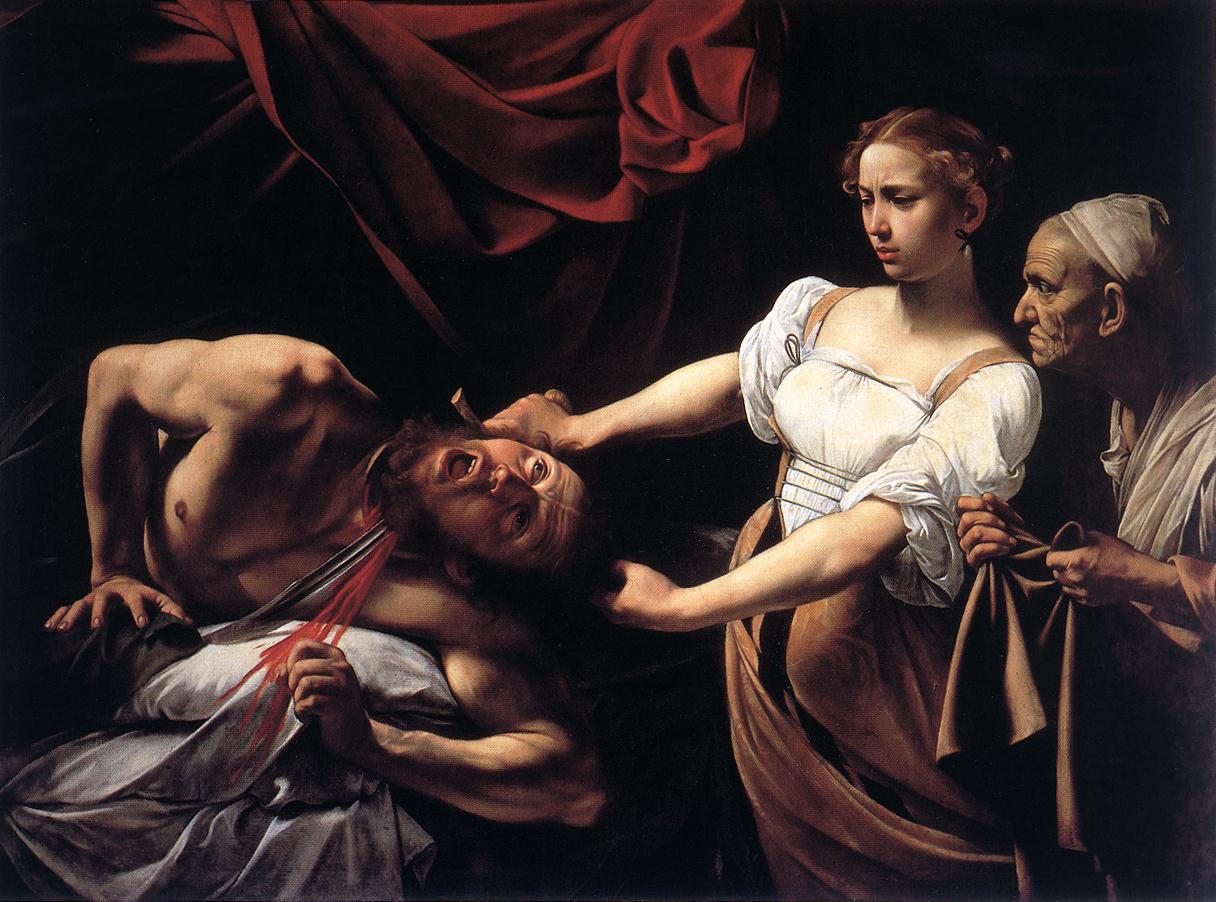

This painting was done by Atremisia Gentileschi. This image is much more graphic in its showing of blood than Carvaggio's, due to Gentileschi's own experience with a man who raped her, so she was not only expressing Judith's emotion in her art but also painting her own past into it. In her image, Holofernes appears to already be dead; his eyes are rolling back into his head and the sheets are spattered with his blood. This Judith is certainly not shying away from the murder, but fiercely holding him down, cutting with determination and without hesitation. The main is no longer just next to Judith, awaiting the head, but ehlping the other woman hold Holoferenes down. Both woman are depicted as normal for their time, without any special gear or dress to hint at what they have done.

This version was painted by Tiziano Vecellio, better known as Titian. In this image, Judith looks much more angelic, with all light focused on her skin and neck. Her face looks serenely calm, as if she wasn't holding a severed head at all. Holofernes is already dead, and her maid is looking at her with an expression that mirrors her own. Both women look to be unaffected by the deed that has just been done. Titian's version is free of any blood or gore, save the severed head, allowing the viewer to focus more on Judith than on a dead or dying body covered in blood (which would usually draw the eye).
Different cultures and time periods also affected the way in which Judith was portrayed in the scene. In Christianity, she is showed as an innocent, praying protected image of a figure that resembles Mary. In Renaissance depictions, the change of Judith's image is described as a fall from grace, no longer resembling Mary but Eve instead. In many of these images, she is shown as a "seducer-assassin," more sexualized and aggressive. Baroque depictions show Judith as flat out violent, but in a way that makes people see her as a vanquisher of adversary. More modern paintings often cast Judith nude and holding a weapon, most frequently a sword. All in all, different artists with different styles have created many different versions of Judith's slaying of Holofernes, but all of these works show her as a brave woman who was able to bring peace to her people by bravely destroying an enemy.

No comments:
Post a Comment
Note: Only a member of this blog may post a comment.